
Reporting house Kosovo – don’t miss it
By Christian Jennings, guest writer for Balkan Natural Adventure
I first stood in the shadow of the Accursed Mountains in the early winter of 1999, looking up at the cobalt sky and snow-topped peaks that lay on the borders of Kosovo, Albania and Montenegro. The temperature was twelve degrees below zero, and around me in the western Kosovo town of Peje life was a thundering urgency of construction and rebuilding.
Thousands of the town’s Kosovar inhabitants, recently returned from refugee camps in Albania, now repaired homes damaged by Serb forces in the guerilla war and NATO bombing campaign that had ended four months previously in June 1999. Light snow frosted the helmets of Italian soldiers from NATO’s Kosovo Force contingent, patrolling on foot and in armoured cars, there to keep a fragile peace.
I was a war correspondent in those frenetic, calamitous days, and that spring of 1999 and the preceding winter, the Accursed Mountains and the high, rigorous peaks along the Kosovo-Albania-Macedonia border further south had represented a barrier for myself and my journalist colleagues. Travelling alongside the guerilla fighters from the Kosovo Liberation Army, and trying to get access to a war-torn Kosovo still dominated by atrocity-prone Serb paramilitary police and soldiers, the silent mountains lay in our paths. Some of my colleagues made it across, though the majority of foreigners you found in the mountains in early 1999 would have been secretive squads of British, American, German and French special forces.
I stayed on in Kosovo for three years after NATO’s 1999 intervention, reporting on the province’s tremulous return to peace, and then returned in 2008 for its declaration of independence. Now, eighteen years later, the Accursed Mountains and those other wild, majestic peaks that were once the preserve of guerilla fighters and special forces are again the stamping ground of wolves, deer, lynx and mountain sheep, as well as guided or solo groups of hikers keen to experience these incredible landscapes, assisted by leading companies such as Balkans Natural Adventure. I will return to these mountains, and to the towns and countryside of Kosovo, Albania and Montenegro in other articles. But in this I wanted to highlight a museum in the capital, Pristina, that recalls those days of war and reporting, and which tells part of the story of how Kosovo came to be as it is today.
On Mother Theresa Avenue in the centre of Prishtina, just next to the big statue of Albanian hero Skenderbeg on his horse, you can find Reporting House. It is an imposing, modern structure, curiously enough set inside an old Yugoslav department store. It has already attracted 30,000 visitors in the first two years since it opened, and the interior of the imposing old building is now stripped back to structural, quasi-industrial basics amply suited to its new contents.
A large, striking installation sits outside: it is made from scarred and burned timbers from houses torched during the war. Inside displays show what happened in Kosovo during its crucial years of independence conflict and liberation movement that began in the 1990s, and which lead inexorably to the birth of the guerrilla Kosovo Liberation Army, and the full-scale conflict with Serbia in 1998-1999.
One of the first exhibits the visitor sees is an old Sony mobile phone that has stopped a high-velocity rifle bullet. The smashed device was in the belt-bag of Vaughan Smith, a British BBC television cameraman, who was shot at while filming Serbian forces attacking an Albanian village in Kosovo’s Drenica valley in 1998. The phone probably saved his life.
His TV footage was just some of the world-wide media coverage in 1998 and ’99 that showed the bloody reality of Yugoslav President Slobodan Milosevic’s brutal campaign of ethnic cleansing of Albanians inside Kosovo. It would help sway world opinion, leading to NATO airstrikes and a massive humanitarian and military intervention.
Reporting House tells the extraordinary story of this climactic time, with around 500 photographs, 150 television reports, and works and installations by artists from as far apart as Kosovo and the wider Balkans, all the way to Mozambique. There are heart-gripping personal testimonies displayed too, which tell the human story of the tumultuous events in Kosovo that have shaped it ever since the break-up of Yugoslavia.
Among these are the love letters of two rebel Kosovo Liberation Army fighters, Fehmi and Xheve Lladrovci, a couple who hid out in the hills together, fought together and eventually died together in a firefight against the Serbs in September 1998. At the other end of the visual spectrum, the museum houses an original armoured Landrover Defender, as used by journalists in Kosovo, this one scarred and dented by the wear and tear of conflict.
This is a museum like no other, and the visitor is offered a new and different perspective on war and the mass movement of people, and what cards history dealt. The story is from Kosovo, but ultimately it is about human beings at their moment of truth, and it is a universal story for our times.
Visitors can explore the museum independently or join a guided tour – all of it free of charge.
EXODUS ’99
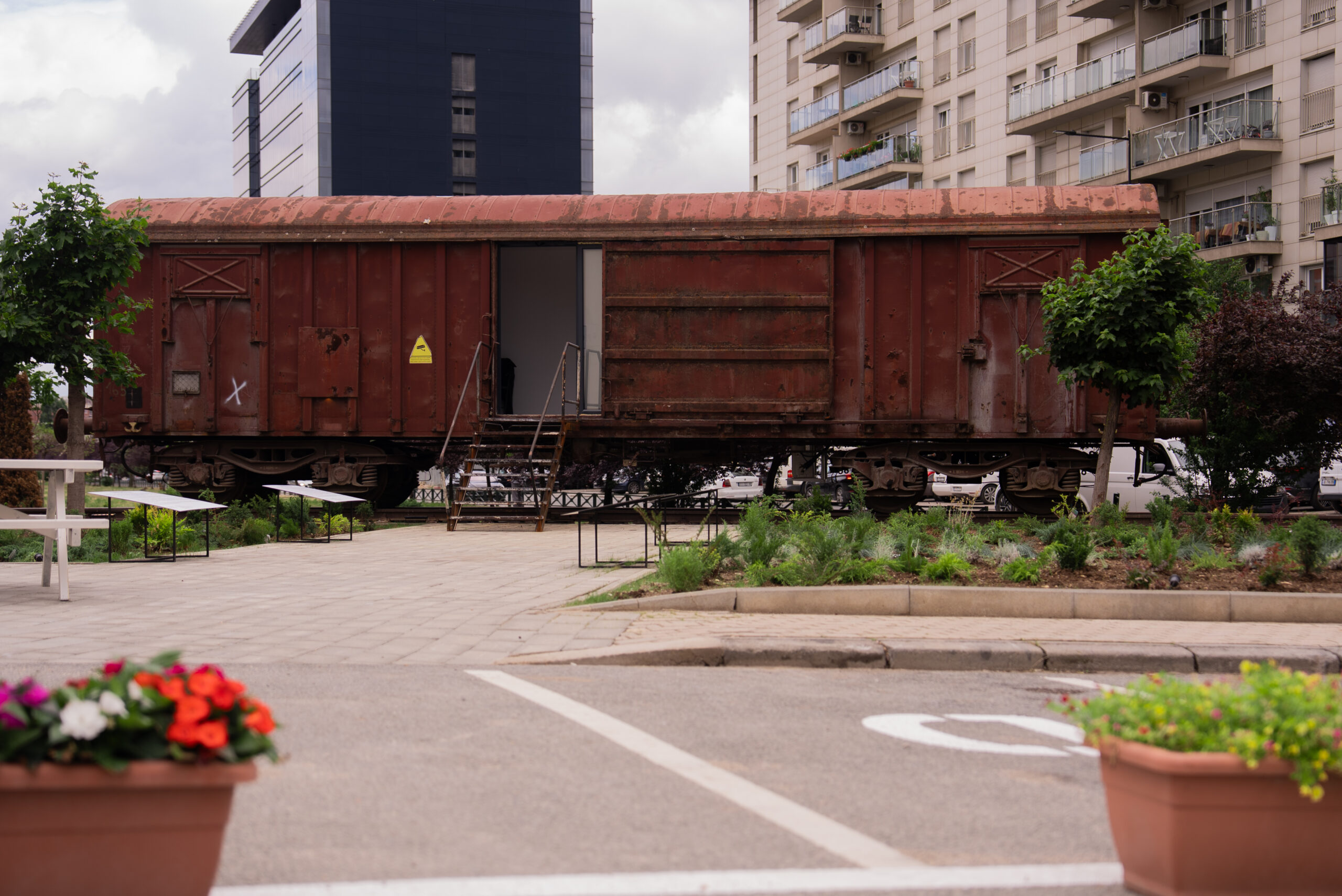
Meanwhile, across the city at Prishtina Train Station, Reporting House has recently opened its second museum, which is called Exodus ’99. This is dedicated solely to the visual commemoration of the mass expulsion of half of the population of Kosovo in 1999.
The museum is housed inside an old railway wagon, itself reminiscent of other mass movements of human beings in recent history. It was used to transport refugees during the war, and sits on the very same railway line on which, in a bitter, snowy winter, hundreds of thousands of people were expelled across towards North Macedonia. A gallery beside the wagon presents artifacts connected to these experiences.
Both museums are produced by Jeta Xharra, who runs the Balkans Investigative Reporting Network in Kosovo, a leading regional journalism organisation. The curator is Gazmend Ejupi, founder of Pristina Bienniale.
PLAN YOUR VISIT
REPORTING HOUSE
Tuesday to Sunday
10:00–18:00
EXODUS ’99
Tuesday to Sunday
12:00–18:00
Monday closed
Phone: +383 48 831 998
Instagram: @reportinghouse
Facebook: Reporting House